
Hawai’ian Military Land Lease and Renewal Efforts
Introduction
Amid current land lease renewal efforts, the U.S. Army has experienced various setbacks concerning Oahu land holdings that it leases from the State of Hawaii. For this effort, the Army has submitted a Final Environmental Impact Statement (FEIS) to the state Board of Land and Natural Resources. The FEIS is a critical step in the land lease process. The Army’s leased lands in Oahu include portions of the Kahaku Training Area, the Kawailoa-Poamoho Training Area, Pohakuloa Training Area, and the Makua Military Reservation. Due to the lease expiring in 2029, the Army is pushing for an expedited land lease renewal process.[1]
Military Land Lease and Renewal
Whether actively in use or vacant, the military owns and leases a vast array of buildings, lands, and other assets throughout various communities in the U.S. To maximize value, certain military properties can be leased to state governments, private entities, and other organizations under federal law. The land lease and renewal process, governed by 10 U.S.C. 2667, guarantees that leases serve public and military interests. Before the property can be leased, it must be determined by the military that it is not necessary for any immediate defensive purposes.[2]
Under 10 U.S.C. 2667, real or personal property can be leased by the secretary of a military department. This type of property can be leased under their jurisdiction when it is not needed for public use. The Secretaries of the Navy, Army, and Air Force all have the authority to approve leases that further their objectives and national security interests. In order to determine if property is required for defensive purposes, the Department of War (DoW) and pertinent military branches must conduct an assessment to determine if the leasing interferes with operational readiness.[2]
Additional criteria for leases include compliance with the National Environmental Policy Act (NEPA) and other pertinent federal regulations. Leases must also actively promote American interests, including strategic partnerships, economic benefits, and job creation. Military installation lands have been leased for myriad purposes, including energy projects, agriculture, government office space, educational institutions, and municipal management services. Another important component in land lease agreements is the Enhanced Use Lease (EUL) program, which facilitates agreements by allowing the development of military land by private entities. In exchange for this development, private entities must provide financial compensation and in-kind considerations that may include providing services or other non-cash assets as payment.[2]
A variety of property types are eligible for lease to support military and community efforts. Military properties eligible for lease include land, airfields, office buildings, training grounds, and test ranges. If tied to immediate military needs, both vacant land and developed infrastructure can be leased. Research labs are often deemed properties of high-value that can be leased to support artificial intelligence, cybersecurity, and unmanned systems efforts. Overall, military property leases benefit industrial efforts, research applications, and community uses. These lease efforts simultaneously support the community, the military, and national security efforts by providing potential opportunities for all parties.[2]
Hawai’ian Military Land
U.S. Army leadership is actively trying to scale back Oahu land holdings in Hawaii. As such, the service is in the process of renewing leases for land they hold from the state. The leased land in Oahu includes 782 acres at the Makua Military Reservation, 4,390 acres at the Kawailoa-Poamoho Training Area, and 1,150 acres at the Kahuku Training Area. The Army originally obtained these lands and a state parcel of 22,750 acres at Pohakuloa in 1964 for $1. These leases will expire in 2029.[1]
It is proposed that the Army retain 19,700 acres of land at the Pōhakuloa Training Area and 450 acres of land at the Kahuku Training Area. The Kahuku land has especially proven useful to the Army and jungle warfare training efforts. The figure below illustrates the Pōhakuloa Training Area and the Kahuku Training Areas.[1],[3],[4]
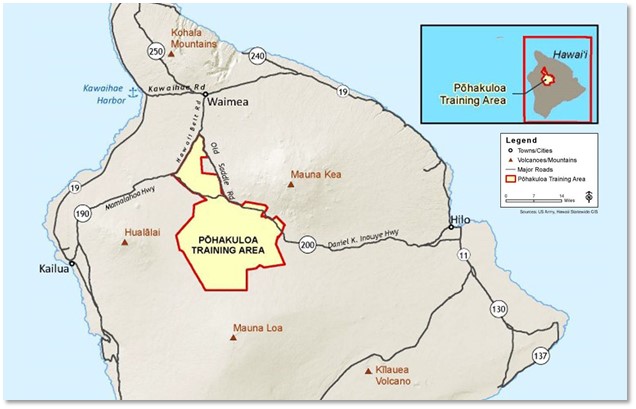
Figure 1 – Pōhakuloa Training Area[5]
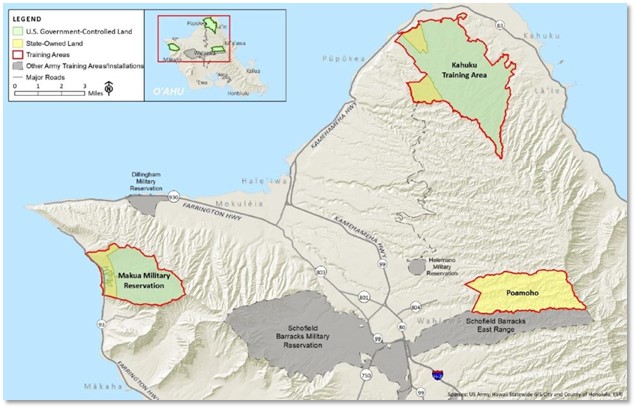
Figure 2 – Kahuku Training Area[5]
A FEIS is a critical component of the Army’s land lease renewal process, required to assess environmental and cultural impacts and meet compliance standards under state and federal law. Previous FEIS drafts have been returned due to deficiencies in data, stakeholder engagement, and environmental analysis. In May 2025, the state Board of Land and Natural Resources (BLNR) voted 5–1 to reject the Army’s most recent FEIS and its efforts to retain land at the Pōhakuloa Training Area. To help establish a baseline for future negotiations, an appraisal was proposed. However, community members opposed the idea, fearing that hiring an appraiser would signal an imminent lease renewal. The Army has been working to revise its impact statements to meet approval standards, a process that has already taken approximately two (2) years to address departmental feedback.[1],[6]
Despite these efforts, the BLNR estimates that the full review and compliance process will extend through 2028. Once the FEIS is accepted, the Army must still obtain a Conservation District Use Permit. Given these procedural requirements and the approaching 2029 lease expiration, it will be challenging for the Army to complete the necessary steps in time.[1]
As part of the Oahu FEIS, the Army opted for a 93% reduction in acreage. In the preferred-alternatives section of the document, the Army specified that they would prefer to lease 450 acres at the Kahuku area instead of renewing leases at the Makua Military Reservation or the Kawailoa-Poamoho Training Area. However, the document was not approved due to data gaps. Areas of criticism in the study include the lack of documented cooperation with the Army and the Hawaii State Aha Moku Advisory Committee and outdated environmental data. Overall, the Army FEIS did not meet the Hawaii Environmental Policy Act standards. Moving forward, the Army plans to work with the BLNR to improve their reporting process, create cost estimates, and set schedules. An alternative approach the Army may consider includes a land swap between the state and military before the 2029 lease expiration date.[1]
Community Impact and Future Implications
The leased lands have an impact on both the community and Army operations. Although the land may be critical for jungle warfare training efforts, it is also important for environmental and cultural interests of the state. The Army published a recent FEIS for land retention, and it is now under review.
The Army-BLNR partnership is strong, and the two (2) groups plan to discuss ways to support all stakeholders. The BLNR believes that the Army has acknowledged the critical location of these sites but that they need to include more information about the community’s perspectives, regulations, and legal implications. However, the Office of Hawaiian Affairs has raised concerns. The last draft of the FEIS failed to acknowledge the fact that the lands are not just state lands, but a part of the larger Crown and Government Lands of the Hawaiian Kingdom. As the lease process continues, there is still a possibility for land swaps between the military and state or land purchases.[1]
The community and the Office of the Governor still acknowledge that the Army’s effort to create a smaller footprint in Oahu showcases a larger commitment to the community and environmental impacts to the area. The community also highlights the importance of the land in regard to military readiness. As the process continues, the Army will need to incorporate more community and environmental impacts into their products, along with overall military readiness. While the FEIS supports decision-making efforts, a separate review and determination is required to make a final decision about the land. In order to allow for input from community members and construct solutions, the Engage Hawaii website is a place for continued involvement. The site will continue to provide updates on land developments and updates on the lease process.[7],[8],[9],[10]
Portions of the community remain opposed to the Army’s land use. Over the last 30 years, groups like Mālama Mākua and Earthjustice have prompted the Army to honor former promises and return the land. Mālama Mākua and Earthjustice urge the Army to return the lands at Mākua, Kahanahāiki and Ko‘iahi that have been used for live fire training and under control of the Army since 1942. In May 2025, the Army agreed to return portions of the land to the state for culturally appropriate usage. Before this process can occur, an in-depth cleanup effort must be made to clear the area of unexploded ordinances. This decrease in land correlates to the Army’s proposal to only retain around 450 acres at the Kahuku Training area and lease land at Poamoho near Wahiawā in 2029.[11]
As the lease process develops, the Army will encourage community involvement while still prioritizing critical training efforts. This efforts showcase the Army’s commitment to operations, the community, and overall environmental impacts of land use. In order to foster community engagement, the Army will need to continue working with dissenting groups as well. While land swaps between the military and state or land purchases still remain a possibility, the Army is hopeful that the lease process will be successful. Community members and Army personnel will continue with these efforts as the 2029 deadline approaches.
[1] CIBA. (2025, July 3). Army Land Retention Efforts in Hawaii Stalled Again. CIBA. Retrieved from https://news.cibassoc.org/army-land-retention-efforts-in-hawaii-stalled-again/.
[2] Legal Clarity Team. (2025, March 28). 10 U.S.C. 2667: Leasing Military Property Explained. Legal Clarity. Retrieved from https://legalclarity.org/10-u-s-c-2667-leasing-military-property-explained/.
[3] State of Hawai’i Engage Hawai’i. (n.d.). Army Training Lands. State of Hawai’i Engage Hawai’i. retrieved from https://engage.hawaii.gov/army/.
[4] Heaton, T. (2024, April 18). The Days Of The Army Leasing Land In Hawaii For $1 Are Likely Over. But What’s Next? Honolulu Civil Beat. Retrieved from https://www.civilbeat.org/2024/04/the-days-of-the-army-leasing-land-in-hawaii-for-1-are-likely-over-but-whats-next/.
[5] State of Hawaiʻi. (n.d.). Army Training Lands. Engage Hawaiʻi. Retrieved from https://engage.hawaii.gov/army/.
[6] Kelleher, J. (2025, May 12). Army hits setback as Hawaii board votes to reject environmental study. The Associated Press. Retrieved from https://www.armytimes.com/news/your-army/2025/05/13/army-hits-setback-as-hawaii-board-votes-to-reject-environmental-study/.
[7] News Release. (2025, June 28). No Surprise: BLNR Rejects Another Army EIS. Hawai’i Free Press. Retrieved from https://www.hawaiifreepress.com/Articles-Main/ID/45780/No-Surprise-BLNR-Rejects-Another-Army-EIS.
[8] Mizuo, A. (2025, September 3). State website seeks to improve transparency on Army land lease negotiations. Hawai’i Public Radio. Retrieved from https://www.hawaiipublicradio.org/local-news/2025-09-03/state-website-seeks-to-improve-transparency-on-army-land-lease-negotiations.
[9] Kaua’i Now. (2025, September 2). Voice your opinions, concerns through new website on future of U.S. Army leases in Hawai‘i. Kaua’i Now. Retrieved from https://kauainownews.com/2025/09/02/voice-your-opinions-concerns-through-new-website-on-future-of-u-s-army-leases-in-hawaii/.
[10] CIBA. (2025, May 12). Army Hits Snag in Effort to Keep Hawaii Training Range Land. CIBA. Retrieved from https://news.cibassoc.org/army-hits-snag-in-effort-to-keep-hawaii-training-range-land/.
[11] Richardson, M. (2025, May 19). Activists surprised by Army’s willingness to let go of state-land lease. Hawaii News Now. Retrieved from https://www.hawaiinewsnow.com/2025/05/20/activists-surprised-after-army-willing-let-go-makua-state-land-lease-2029/.