
Operation Epic Fury: Operational Snapshot and Strategic Outlook
Introduction
After months-long negotiations failed to produce a binding agreement over Iran’s nuclear program, ballistic missile development, and regional proxy activity, the United States and Israel launched Operation Epic Fury on 28 February 2026 at approximately 1:15 a.m. EST. U.S. and Israeli forces conducted coordinated strikes against high-value targets within Iran, including Islamic Revolutionary Guard Corps (IRGC) command-and-control nodes, integrated air defense systems, missile and unmanned aerial vehicle launch infrastructure, and key military airfields. President Donald Trump stated that the objectives of the conflict are fourfold: (1) to degrade Iran’s missile capabilities; (2) to neutralize the operational capacity of the Iranian Navy; (3) to prevent Iran from developing or acquiring nuclear weapons; and (4) to compel an end to Iranian state sponsorship of terrorism. Iran conducted retaliatory missile and drone strikes against American military installations across the region in response, including Naval Support Activity Bahrain, Al Udeid Air Base in Qatar, Al Dhafra Air Base in the United Arab Emirates, Ali Al Salem Air Base in Kuwait, and Muwaffaq al-Salti Air Base in Jordan. U.S. force posture in the Middle East remains substantial, with approximately 45,000 to 50,000 personnel deployed across multiple locations, all of whom remain at elevated risk from missile, drone, and proxy attacks. This comes despite a temporary ceasefire initiated in April 2026 and subsequent intermittent violations. As of April 2026, U.S. military casualties have increased beyond initial reporting, with multiple service members killed and dozens wounded in missile, drone, and indirect fire attacks. During the opening phase of operations, a U.S. F-15E Strike Eagle was shot down over Iranian territory on 03 April 2026. Both crew members ejected, and U.S. forces conducted a multi-day operation that recovered the pilot within hours and the second crew member after approximately two (2) days in contested terrain.[1],[2],[3],[4],[5],[6]
Threat Environment
Iran has historically supported a network of proxy organizations across the Middle East that, in conjunction with its conventional and unconventional forces, has constituted a central component of its hard power strategy. Tehran has referred to this network as the “Axis of Resistance,” which has included groups such as Hamas, Hezbollah, and the Houthis, as well as affiliated militias operating in Iraq and Syria. Since the onset of Operation Epic Fury, elements of this network have been degraded through sustained U.S. and Israeli strikes, though multiple groups retain residual capability and have continued intermittent attacks across the region. Iran itself has traditionally maintained one of the largest military forces in the Middle East, currently fielding approximately 600,000 to 650,000 active-duty personnel across the regular armed forces and the IRGC, supported by an estimated 300,000 to 350,000 reservists and the ability to mobilize additional paramilitary forces, including Basij elements, bringing total potential manpower to near or above one (1) million personnel. Due to longstanding sanctions and procurement restrictions, Iran has prioritized domestic defense production, resulting in a broad inventory of indigenous weapons systems, including ballistic missiles, armored vehicles, and unmanned aerial platforms. Portions of this inventory have been degraded by ongoing combat operations in 2026. A critical component of Iran’s military capability remains its ballistic missile arsenal, assessed as the largest and most diverse in the Middle East, consisting of thousands of ballistic and cruise missiles with ranges extending to approximately 2,000 kilometers or more, enabling strikes across the region and into Eastern Europe. Iran has also developed a significant unmanned aerial system (UAS; or “drones”) capability, employing systems for both reconnaissance and strike missions, with loitering munitions such as the Shahed-136 designed to saturate air defense networks and conduct precision strikes against infrastructure and military targets.[7],[8],[9],[10]
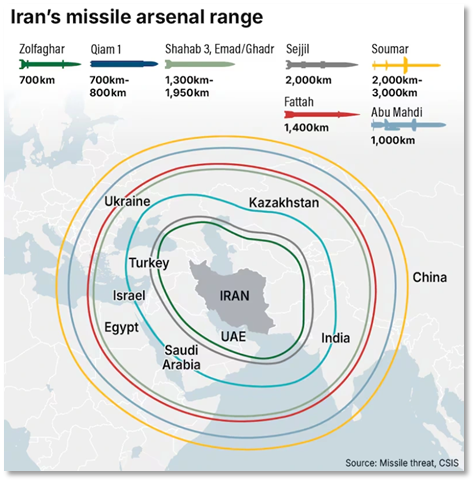
Figure 1 – Iranian MRBM range[8]
Closing of the Strait of Hormuz
Following the escalation of Operation Epic Fury, Iran moved to restrict maritime traffic through the Strait of Hormuz by targeting and threatening commercial and military vessels transiting the waterway. While the strait has not remained uniformly closed, transit has been severely disrupted, with shipping volumes declining from pre-conflict averages of approximately 140 vessels per day to single-digit daily transits during peak disruption periods. This degradation reflects a combination of Iranian actions, including missile threats, vessel seizures, and suspected naval mine deployments, alongside a concurrent U.S. maritime response.
On 13 April 2026, the U.S. initiated a naval blockade targeting Iranian ports and shipping, enforced by U.S. Central Command through a combination of surface combatants, aircraft, and maritime interdiction forces, with more than 10,000 personnel and multiple naval assets assigned to the mission. The blockade has focused on preventing vessels from entering or departing Iranian ports while allowing limited transit between non-Iranian ports under constrained conditions, resulting in a dual-pressure environment in which both Iran and the U.S. have restricted maritime access. This disruption has had immediate implications for the operations of American military installations in the region, particularly through constrained access to critical commodities. In addition to the global impact on oil supply, restricted maritime transit has affected the availability of industrial materials such as sulfur, a key input in the production of sulfuric acid used in refining, electronics manufacturing, and battery production, all of which support military logistics and infrastructure. As the conflict has progressed, prolonged supply chain disruption has increased pressure on U.S. basing and sustainment operations, particularly at installations already under intermittent attack. Efforts to mitigate the disruption have included U.S. and allied naval operations to secure maritime corridors and ongoing mine-clearing and interdiction activities. However, the geographic constraints of the Strait of Hormuz, which narrows to approximately 10 miles at its tightest point, continue to present significant operational risk. U.S. and allied vessels operating in this environment remain vulnerable to Iranian anti-ship missiles, UAS, naval mines, and coastal defense networks positioned along the littoral, complicating efforts to sustain freedom of navigation. Despite intermittent diplomatic efforts and temporary reopening announcements, the continued U.S. blockade of Iranian shipping and Iran’s retaliatory restrictions have prevented a full normalization of traffic, leaving the strait in a persistently degraded operational state and preserving it as a central source of strategic leverage for both sides.[11],[12],[13],[14],[15]
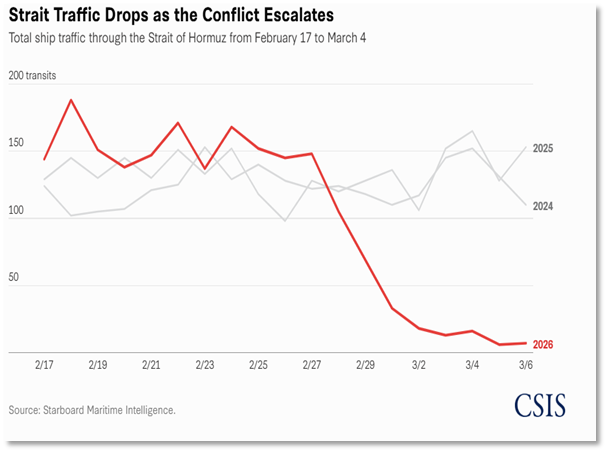
Figure 2 – Ship traffic in Strait of Hormuz[11]
An Existential Threat (To Iran)
One factor distinguishing this phase of conflict from prior U.S.–Iran exchanges is the expanded scope of targeting directed at senior Iranian leadership and command structures rather than limited retaliatory strikes. The U.S., in coordination with Israel, has conducted a series of precision strikes against high-ranking military and security officials, including senior IRGC commanders, defense leadership figures, and elements of Iran’s national security apparatus. While these operations have significantly degraded Iran’s command-and-control continuity, reporting indicates that the IRGC has tightened its grip on wartime decision-making despite leadership losses, and core elements of the regime’s governing structure remain intact and operational. As a result, Iran continues to prosecute the conflict through remaining command elements and decentralized IRGC-affiliated networks. This dynamic has contributed to sustained Iranian use of missile and UAS against U.S. and allied targets, reflecting a continued willingness to expend munitions to maintain strategic relevance. From a conflict trajectory perspective, pathways to deescalation remain uncertain. Constraints on U.S. logistics stemming from disruption in the Strait of Hormuz, combined with domestic political pressure, could influence U.S. decision-making regarding negotiations. On the Iranian side, official statements have publicly rejected assertions of active peace negotiations, and the regime has signaled intent to continue operations despite battlefield losses, indicating that the conflict may be extended by both strategic considerations and internal political dynamics.[16],[17],[18]
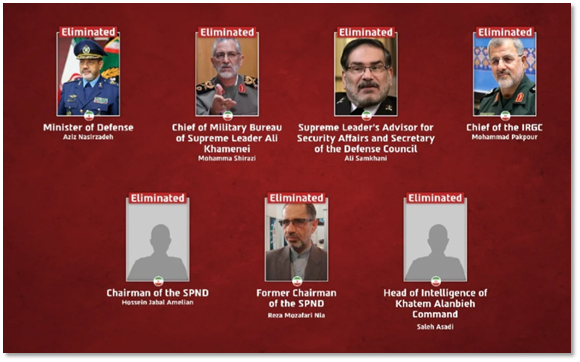
Figure 3 – High-ranking members of Iranian regime killed[19]
Next Steps
The Iranian regime has experienced significant degradation of senior military leadership and operational infrastructure. However, it remains intact and continues to function through surviving political institutions and decentralized command structures, particularly within the IRGC. U.S. military installations across the Middle East continue to face persistent and realized threats from Iranian missile, drone, and proxy attacks, requiring sustained force protection measures and dispersal of critical assets. Concurrently, disruption of maritime traffic through the Strait of Hormuz has constrained the flow of resources, creating growing concern regarding the sustainability of military operations and base infrastructure over time. In the near term, additional targeted strikes against Iranian military leadership and command nodes are likely to continue as part of ongoing efforts to further degrade Iran’s operational capacity, though complete collapse of the regime is not as likely as once postulated. The U.S. and its allies continue to emphasize securing maritime transit through the Strait of Hormuz, including the use of naval and aerial escort operations, mine countermeasure activities, and interdiction enforcement tied to the broader blockade posture. The success of these efforts remains contingent on mitigating Iranian anti-ship and asymmetric capabilities in a geographically constrained environment. Even if maritime access is partially restored, Iran is expected to retain the ability to impose intermittent disruption, preserving a degree of strategic leverage. Broader conflict trajectory remains uncertain and will be influenced by operational developments, sustainment capacity, and political decision-making in Washington and Tehran. External actors, including Russia and China, have not directly intervened but continue to monitor the situation, and their posture may shift in response to escalation dynamics or perceived threats to regional stability and economic interests.[13],[15],[20]
The conflict is likely to enter a protracted phase defined by incremental gains, periodic escalation, and continued competition across military, economic, and informational domains. U.S. and allied decision-making will center on balancing sustained operational pressure with resource allocation and broader strategic priorities, particularly as the duration of the conflict increases. Iran, for its part, is expected to continue leveraging asymmetric tactics and regional networks to offset conventional disadvantages and impose costs over time. The absence of a clear off-ramp, combined with competing objectives and limited incentives for concession, suggests that near-term resolution remains unlikely. As a result, the operational environment will continue to demand adaptability, resilience, and sustained coordination among American, Israeli, and other partner forces, with outcomes shaped as much by endurance and strategic alignment as by discrete battlefield developments.
As of 03 May 2026, the conflict has transitioned into a sustained phase of managed escalation characterized by intermittent strikes, contested maritime access, and continued Iranian reliance on asymmetric and distributed operations, consistent with recent reporting. Iranian forces and affiliated elements continue to conduct periodic missile and unmanned aerial system (UAS) attacks, while U.S. and Israeli operations remain focused on targeted degradation of residual military infrastructure, leadership nodes, and logistics networks. The Strait of Hormuz remains operational but constrained, with ongoing threats to commercial shipping preserving a degraded but functional transit environment. Despite losses to senior leadership and infrastructure, Iran has demonstrated the ability to regenerate limited operational capacity and maintain pressure through decentralized command structures and proxy activity, particularly in Iraq, Syria, and maritime approaches. Current indicators suggest neither side is pursuing decisive escalation, instead operating within a framework of calibrated military action designed to preserve strategic leverage while avoiding full-scale regional war, reinforcing assessments that the conflict is entering a prolonged containment phase dependent on endurance, sustainment, and shifting regional dynamics.[21]
[1] The White House. (2026, March 12). Operation Epic Fury: Decisive American Power to Crush Iran’s Terror Regime. Retrieved from Operation Epic Fury: Decisive American Power to Crush Iran’s Terror Regime – The White House.
[2] Lemieux, F. (2026, March 2). Iran Responds to Operation Epic Fury with Layered Military, Cyber, and Proxy Strategy Amid Escalation Constraints. GTSC. Retrieved from: Iran Responds to Operation Epic Fury with Layered Military, Cyber, and Proxy Strategy Amid Escalation Constraints – HSToday.
[3] U.S. Military Presence in The Middle East. (2024, Januray 31). Graphic News. Retrieved from MILITARY: U.S. troop presence in Middle East infographic
[4] Miller, A & Wile, B. (2026, March 5). Honor the Fallen Service Members of Operation Epic Fury. Military.com. Retrieved from Honor the Fallen Service Members of Operation Epic Fury | Military.com
[5] Associated Press. (2026, April 5). What to know about the rescue of a US aviator in Iran. AP News. Retrieved from https://apnews.com/article/iran-us-pilot-military-rescue-fde473d07fb59e871a71cd2ad2ffe4fe
[6] Associated Press. (2026, April 6). Trump details rescue of US crew downed in Iran. AP News. Retrieved from https://apnews.com/article/iran-war-fighter-jet-rescue-trump-7d8cfb6d0fd400abdc71f8c9d67408fe
[7] McDonnell, P. (2026, March 1). Iran’s ‘Axis of Resistance’: The proxy forces shaping Mideast conflicts. Los Angelas Times. Retrieved from Iran’s ‘Axis of Resistance’: The proxy forces shaping Mideast conflicts – Los Angeles Times
[8] Pierce, L. (2025, April 14). How Strong Is Iran’s Military? An In-Depth Analysis. DefenseFeeds. Retrieved from How Strong Is Iran’s Military? An In-Depth Analysis
[9] International Institute for Strategic Studies. (2025, February 12). The Military Balance 2025. International Institute for Strategic Studies. Retrieved from https://www.iiss.org/publications/the-military-balance/2025/the-military-balance-2025.
[10] Center for Strategic and International Studies. (2026, March 3). Missiles of Iran. Center for Strategic and International Studies. Center for Strategic and International Studies. Retrieved from https://missilethreat.csis.org/country/iran/.
[11] Pretat, H. & Sato, M. Et Al. (2026, March 6). No one, not even Beijing, is getting through the Straight Of Hormuz. CSIS. Retrieved from https://www.csis.org/analysis/no-one-not-even-beijing-getting-through-strait-hormuz.
[12] Bazilian, M. Amoah, M. Matisek, J. (2026, March 13). The Chokepoint We Missed: Sulfur, Hormuz, And The Threats To Military Readiness. Modern War Institute At West Point. Retrieved from https://mwi.westpoint.edu/the-chokepoint-we-missed-sulfur-hormuz-and-the-threats-to-military-readiness/
[13] Lendon, B. The US is considering Hormuz naval escorts. There are risks and it could go disastrously wrong. (2026, March 16). CNN. Retrieved from https://www.cnn.com/2026/03/16/ middleeast/hormuz-strait-us-navy-escorts-analysis-intl-hnk-ml.
[14] Associated Press. (2026, April 18). Iran reimposes restrictions on Strait of Hormuz, accusing U.S. of violating deal to reopen it. WEAU 13 News. Retrieved from https://www.weau.com/2026/04/18/iran-reimposes-restrictions-strait-hormuz-accusing-us-violating-deal-reopen-it/.
[15] Mongilio, H. (2026, April 14). Strait of Hormuz traffic down as U.S. blockade appears to deter some ships. U.S. Naval Institute News. Retrieved from https://news.usni.org/2026/04/14/strait-of-hormuz-traffic-down-as-u-s-blockade-appears-to-deter-some-ships.
[16] Rego, M. (2026, March 2). Iran’s Leaders: Who was killed? Who’s in charge now? The Hill. Retrieved from https://thehill.com/policy/international/5763576-irans-leaders-who-was-killed-whos-in-charge-now/.
[17] Reuters. (2026, March 4). Iran’s Revolutionary Guards take wartime lead, ensuring harder line, sources say. Reuters. Retrieved from https://www.reuters.com/world/middle-east/irans-revolutionary-guards-take-wartime-lead-ensuring-harder-line-sources-say-2026-03-04/.
[18] Maloney, S. (2026, February 24). After Khamenei: Planning for Iran’s leadership transition. Council on Foreign Relations. Retrieved from https://www.cfr.org/reports/leadership-transition-in-iran.
[19] Fabian, E. (2026, February 28). IDF confirms killing top Iranian leaders, including top defense official Ali Shamkhani. The Times Of Israel. Retrieved from https://www.timesofisrael.com/ liveblog_entry/idf-confirms-killing-top-iranian-leaders-including-top-defense-official-ali-shamkhani/
[20] IEA (2026). Oil market report – March 2026. IEA, Paris. Retrieved from https://www.iea.org/ reports/oil-market-report-march-2026.
[21] Institute for the Study of War. (2026, May 3). Iran update special report: May 3, 2026. Institute for the Study of War. Retrieved from https://understandingwar.org/research/middle-east/iran-update-special-report-may-3-2026/.