
Artificial Intelligence in the U.S. Military
Introduction
Artificial intelligence (AI) is rapidly reshaping the way the Department of War (DoW) visualizes, comprehends, and behaves within the many battlespaces that constitute modern warfighting. AI is more than just a collection of tools. It is becoming an integral strategy for decision-making. This allows commanders to process information and make tactical decisions. By leveraging AI for speed, agility, and the capacity to respond within an adversary’s decision cycle, the DoW has deployed AI solutions to create a competitive advantage over threat actors who would target the United States. However, AI is not a “plug-and-play” solution. Military decision-making is combative, high-stakes, and ethically limited. This means that mistakes can lead to escalation, strategic failure, or even negative outcomes for noncombatants. Acknowledging these facts, the DoW has placed a strong emphasis on responsible and reliable AI, including human responsibility, governance, testing, and monitoring into AI systems from conception to implementation. The current AI discussion in defense is characterized by this tension between moving quickly for advantage and slowing down for safety.[1],[2],[3]
Present-day Usage of AI Within the Military
AI is typically used for assistance in decision making, rather than decision replacement. In order to enable troops to “sense,” “make sense,” and “act” more quickly, DoW principles like Joint All-Domain Command and Control (JADC2) focus on integrating sensors and shooters via data, automation, and AI. In situations where timeframes are too short for human processing, the objective is to assist commanders in identifying different patterns. This is done while also filtering noise, and coordinating activities across land, sea, air, space, and cyberspace.[2],[4]
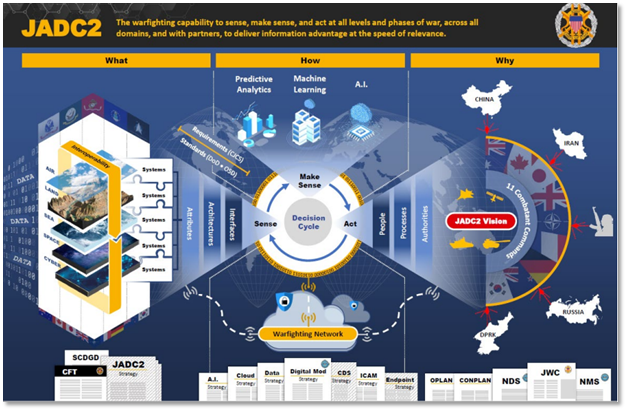
Figure 1 – JADC2 Placemat[2]
An example of the use of AI is Project Maven, which focuses on using machine learning, particularly computer vision, to observe and assess massive amounts of data and full-motion video and identify objects of interest for human analysts. AI may speed up triage and direct human attention in place of analysts viewing endless feeds, cutting down on time-to-insight and improving consistency in detection. This illustrates how AI might alter the speed at which intelligence is produced, which can sometimes influence tactical, operational, and strategic decision-making.[5],[6]
AI-enabled force design approaches that presume highly dispersed processes are also beneficial for decision making. AI decision-support technologies are mentioned in open-source defense assessments on “Mosaic Warfare” and related techniques as a means of managing numerous tiny, networked assets and rapidly adjusting to adversary actions. In some of these scenarios, robots assist in coordinating complexity at machine speed. While this might be beneficial, humans are still in charge of purpose and judgment, particularly in situations when communications are disputed and information is lacking.[7],[8]
Pros & Cons of AI Utilization Within the DoW
AI’s ability to integrate input from myriad sources into a cohesive picture allows the DoW to shorten observe-orient-decide-act cycles. AI can prioritize warnings, spot abnormalities, and offer choices faster. In theory, this can result in “decision advantage,” which is a major stated goal of modernization initiatives for command and control.[2]
Additionally, AI can increase efficiency and precision, particularly in intelligence, surveillance, and reconnaissance (ISR) processes. Machine learning may assist with dispersing attention across large datasets, speeding up item recognition and categorization, and providing analysts with a cohesive intelligence picture.. This can reduce the required number of man hours, increase response capacity, and decrease missed detections, all of which are important in both high-end combat and counterterrorism.[5],[6]
Outside of the battlefield, AI may also streamline personnel management, logistics, maintenance, and resource allocation, areas where minor percentage increases can result in significant readiness advantages. The DoW’s Data, Analytics, and AI Adoption Strategy highlights the importance of high-quality data and how AI can speed up learning, improve operations, and scale best practices. If AI improves interoperable planning and shared situational awareness, coalition operations can benefit. Trust, norms, and responsible practices are all part of DoW’s AI governance effort, which is crucial for allies who might be leery of “black box” technologies or different ethical stances. It is simpler to incorporate AI across partners without compromising legitimacy when it is in line with explicit regulations, transparent testing, and auditable procedures.[1],[3],[9]
Despite its many benefits and promising possibilities, the largest operational danger in the widescale implementation of AI is overreliance. Commanders may act on faulty suggestions in dynamic, misleading circumstances if they have an excessive amount of faith in AI outputs. AI models may exhibit biases present in training data, fail quietly, or deteriorate under different circumstances. DoW must maintain a strict AI policy because these dangers are real and can manifest as misclassification, fragile performance, and poor generalization.[3]
Explainability and accountability are connected challenges. Certain AI systems are challenging to understand or audit, particularly when time is of the essence, but military operations need unambiguous accountability for both fatal and nonlethal effects. The U.S. policy on autonomy in weapon systems places requirements around design, testing, and senior level review to lessen the likelihood and consequences of failures, particularly those that could result in unintentional engagements. The DoW is aware of how dangerous “automation surprise” can be in weapons contexts. AI also adds to the burden of assurance and cybersecurity. Deployment pipelines, training data, and model weights become valuable targets for disruption and espionage. The realization that implementing AI at scale necessitates safeguarding not only networks and endpoints but also the Machine Learning (ML) life cycle, data origin, and model integrity. Addionally, monitoring for drift or compromise is reflected in the DoW’s emphasis on AI assurance, particularly through its enterprise AI leadership structures.[10],[11],[12]
AI is also costly and often challenging to handle. Data infrastructure, governance, testing capacity, and the staffing capable of assessing AI limitations, rather than just purchasing software, are necessary for widespread deployment. AI transformation is as much organizational as it is technological. Victory in the age of AI requires consistent investment, talent pipelines, and institutional adjustments to go from pilots to operational effect.[12]
Artificial Intelligence as a Threat to the Homeland
When AI allows for greater decision-making, robust command and control, and more rapid learning than competitors, it becomes an advantage for the United States and its allies. DoW integrity and strategy places a strong emphasis on “decision advantage,” or the capacity to act inside adversary decision cycles. If this is accomplished, it might discourage aggression by making U.S. forces more difficult to surprise and quicker to respond across different branches and domains. AI-supported operations can tip the scales in favor of the team that senses and adjusts the fastest in a race where speed is crucial. However, because AI is widely available and may be used as a weapon by both state and non-state actors, the same qualities that provide an advantage also pose a threat. Particularly in a world full of sensors and data, national security assessments show that AI can increase cyber vulnerabilities and allow for new types of targeting and manipulation. Adversaries can impose costs without matching U.S. conventional power if they can utilize AI to locate, track, and manipulate U.S. military or domestic systems.[1],[2],[12]
One (1) particular type of danger is adversarial machine learning, where attackers can contaminate training data, avoid detection, extract models, or alter inputs (even in subtle ways). These strategies are arranged using frameworks such as MITRE Adversarial Threat Landscape for Artificial-Intelligence Systems (ATLAS). The National Institute of Standards and Technology (NIST) has also created taxonomies to assist enterprises in identifying and controlling adversarial machine learning risk. These risks indicate that AI systems can be deceived when they are most needed during a crisis or conflict, undermining confidence and causing operational misdirection for the DoW. Additionally, AI has the potential to speed up arms competition and escalation danger, particularly in areas where autonomy interacts with the timeliness of crisis decisions and weaponry. International controversy persists despite U.S. autonomy policy’s emphasis on limiting unintentional engagements and developing formal review systems since autonomy can speed up human decision-making and raise the likelihood of quick mistake. Even minor AI-driven mistakes, such as misidentifying intent, misclassifying targets, or spreading false alarms, might lead to escalation dynamics during a great-power conflict.[11],[13],[14],[15]
More convincing misinformation, impersonation, and uncredible media, as well as the utilization of unauthorized tools by staff members, are additional threats brought on by generative AI. The DoW has published interim advice and toolkits to operationalize guardrails, treating generative AI as a unique risk category, according to official guidelines and public reporting. It follows that “AI advantage” now rests not just on creating models but also on managing their use, security, and integration into mission procedures.[16]
Mitigating the Misusage of Artificial Intelligence
The U.S. approach to AI in defense increasingly emphasizes responsible adoption: clear ethical principles, rigorous testing and evaluation, auditability, and human accountability. DoW responsible AI strategy documents describe implementation pathways designed to reduce uncertainty and help components field AI faster without abandoning trust and oversight. This governance approach matters because legitimacy, domestically and with allies, can be as decisive as technical performance. This is supported by useful risk management frameworks. Adversarial machine learning taxonomies explain how assaults happen and what mitigations are pertinent. On the other hand, NIST’s AI Risk Management Framework (AI RMF) offers a framework for mapping, monitoring, and managing AI risks. Using such frameworks for military decision making might decrease the likelihood that AI systems are deployed without explicit criteria for robustness, dependability, monitoring, and incident response, particularly in hostile environments where subterfuge is anticipated.[3]
Outlook
The development of AI in the military is a strategic capacity that alters decision making while bringing new attack surfaces and failure modes. It is neither exclusively advantageous nor exclusively hazardous. Initiatives centered on command and control and ISR triage clearly demonstrate the benefits of speed, scale, decision advantage, and efficiency. As AI systems are more closely linked to operational choices, the drawbacks, overreliance, opacity, governance costs, and adversary manipulation become more serious. AI benefits the US when it enhances judgment without undermining accountability and when it builds resilience more quickly than it builds vulnerability. Threats arise when enemies can use AI to alter perception, undermine trust, breach systems, or inflict escalation. Whether U.S. defense institutions can field AI quickly, while ensuring proper operability and machine-enabled pace with human responsibility, will be the crucial [6],[13]
[1] DoW. (2023, November). Data, Analytics, and Artificial Intelligence Adoption Strategy. DoW. Retrieved from https://media.defense.gov/2023/nov/02/2003333300/-1/-1/1/DoW_data_analytics_ai_adoption_strategy.pdf.
[2] DoW. (2022, March). Summary Of the Joint All-Domain Command & Control (JADC2) Strategy. DoW. Retrieved from https://media.defense.gov/2022/Mar/17/2002958406/-1/-1/1/SUMMARY-OF-THE-JOINT-ALL-DOMAIN-COMMAND-AND-CONTROL-STRATEGY.pdf.
[3] DoW. (2022, June). U.S. Department of Defense Responsible Artificial Intelligence Strategy And Implementation Pathway. DoW. Retrieved from https://media.defense.gov/2022/Jun/22/2003022604/-1/-1/0/Department-of-Defense-Responsible-Artificial-Intelligence-Strategy-and-Implementation-Pathway.PDF.
[4] Congressional Research Service. (2020, April 06). Defense Capabilities: Joint All Domain Command and Control. Congress. Retrieved from https://www.congress.gov/crs_external_products/IF/PDF/IF11493/IF11493.2.pdf.
[5] Pellerin, C. (2017, July 21). Project Maven to Deploy Computer Algorithms to War Zone by Year’s End. DoW. Retrieved from https://www.war.gov/News/News-Stories/Article/Article/1254719/project-maven-to-deploy-computer-algorithms-to-war-zone-by-years-end/.
[6] NGA. (n.d.). GEOINT Artificial Intelligence. NGA. Retrieved from https://www.nga.mil/news/GEOINT_Artificial_Intelligence_.html.
[7] DARPA. (n.d.). DARPA Tiles Together a Vision of Mosaic Warfare. DARPA. Retrieved from https://www.darpa.mil/news/mosaic-warfare.
[8] Clark, B., Patt, D., & Schramm, H. (2020). Mosaic Warfare Exploiting Artificial Intelligence And Autonomous Systems to Implement Decision-Centric Operations. CSBA. Retrieved from https://csbaonline.org/uploads/documents/Mosaic_Warfare_Web.pdf.
[9] DoW. (2023). Accelerating Decision Advantage. CDAO. Retrieved from https://media.defense.gov/2023/Nov/02/2003333301/-1/-1/1/DAAIS_FACTSHEET.PDF.
[10] DoW. (2023, January 25). Autonomy In Weapon Systems. SecDef. Retrieved from https://www.esd.whs.mil/portals/54/documents/dd/issuances/DoWd/300009p.pdf.
[11] Saylor, K.M. (2025, January 02). Defense Primer: U.S. Policy on Lethal Autonomous Weapon Systems. Retrieved from https://www.congress.gov/crs-product/IF11150.
[12] National Security Commission on Artificial Intelligence. (n.d.). Final Report. NCSAI. Retrieved from https://assets.foleon.com/eu-central-1/de-uploads-7e3kk3/48187/nscai_full_report_digital.04d6b124173c.pdf.
[13] Vassilev, A., Oprea, A., Fordyce, A., & Anderson, H. (2024, January). Adversarial Machine Learning: A Taxonomy and Terminology of Attacks and Mitigations. NIST. Retrieved from https://csrc.nist.gov/pubs/ai/100/2/e2023/final.
[14] Boutin, C. (2023, January). NIST Identifies Types of Cyberattacks That Manipulate Behavior of AI Systems. NIST. Retrieved from https://www.nist.gov/news-events/news/2024/01/nist-identifies-types-cyberattacks-manipulate-behavior-ai-systems.
[15] ATLAS. (n.d.). MITRE ATLAS. ATLAS. Retrieved from https://atlas.mitre.org/.
[16] Vincent, B. (2023, November 09). New interim DOW guidance ‘delves into the risks’ of generative AI. Defense Scoop. Retrieved from https://defensescoop.com/2023/11/09/new-interim-DoW-guidance-delves-into-the-risks-of-generative-ai/.